
Subaru Outback (BR): Vehicle capacity weight
Subaru Outback (BR) 2010-2015 Owners Manual / Driving tips / Loading your vehicle / Vehicle capacity weight
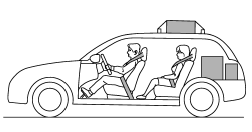
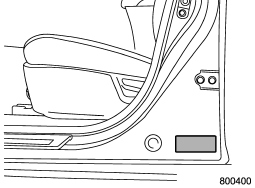
The load capacity of your vehicle is determined by weight, not by available cargo space. The maximum load you can carry in your vehicle is shown on the vehicle placard attached to the driver’s side door pillar. It includes the total weight of the driver and all passengers and their belongings, any optional equipment such as a trailer hitch, roof rack or bike carrier, etc., and the tongue load of a trailer.
READ NEXT:
 GVWR and GAWR (Gross Vehicle Weight Rating and Gross Axle Weight Rating)
Certification label
The certification label attached to the driver’s side door shows GVWR (Gross
Vehicle Weight Rating) and GAWR (Gross Axle Weight Rating).
The GVW (Gross Vehicle Weight) must
Roof rails with integrated crossbars (Outback)
1) Integrated crossbars
CAUTION
● For cargo carrying purposes, the bars must be used as crossbars and be used
together with the genuine SUBARU carrying attachment. The bars must never be u
Installing carrying attachments on the crossbars
When installing any carrying attachment such as a bike carrier, ski carrier,
kayak carrier, cargo basket, etc. on the crossbars, follow the manufacturer’s instructions
and make sure that the att
SEE MORE:
Foreword, Specifications
Foreword
HOW TO USE THIS MANUALS
1. STRUCTURE
Each section consists of SCT that are broken down into SC that are divided into sections for each component.
The specification, maintenance and other information for the components are included, and the diagnostic information has also been added where ne
Refueling in cold weather
To help prevent moisture from forming in the fuel system and the risk of its
freezing, use of an antifreeze additive in the fuel tank is recommended during cold
weather. Use only additives that are specifically designed for this purpose. When
an antifreeze additive is used, its effect lasts lo
© 2010-2026 Copyright www.suoutback.com
