
Subaru Outback (BR): Temperature control button
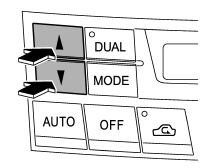
Driver’s side
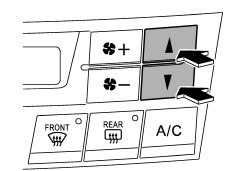
Passenger’s side
To increase the temperature setting, press the “ ”
”
side of the temperature control button. To decrease the temperature setting, press
the “ ” side of the temperature control
button.
Each temperature setting is shown on the display. When the “LO” is shown, the system provides maximum cooling performance. When the “HI” is shown, the system provides maximum heating performance.
DUAL mode
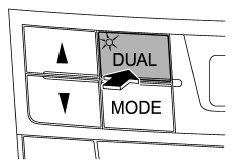
It is possible to make separate temperature settings for the driver’s side and passenger’s side (DUAL mode).
To activate the DUAL mode: Press the “DUAL” button. When the DUAL mode is activated, the indicator light on the “DUAL” button illuminates.
To deactivate the DUAL mode:
Press the “DUAL” button again. When the DUAL mode is deactivated, the indicator light on the “DUAL” button turns off and the temperature setting for the front passenger’s side becomes the same as the setting for the driver’s side.
READ NEXT:
 Defroster button
To defrost or dehumidify the windshield
and front door windows, press the defroster button “”.
When the “” button is pressed, the
air conditioner compressor automatically operates to
Fan speed control button
The fan speed control button has 6 different fan speed positions. The fan speed
is shown by the display.
A/C – Air conditioner button
If the windshield starts to fog when the climate control system is operated in
the AUTO mode, press the air conditioner button “A/C” to defog and dehumidify. When
this button is pressed, the
SEE MORE:
Charge warning light
If this light illuminates when the engine is running, it may indicate that the
charging system is not working properly.
If the light illuminates while driving or does not turn off after the engine
starts, stop the engine at the first safe opportunity and check the alternator belt.
If the be
Front ABS Wheel Speed Sensor
A: REMOVAL
1) Disconnect the ground cable from battery.
2) Lift up the vehicle, and then remove the front wheels.
3) Remove the front ABS wheel speed sensor.
CAUTION:
Be careful not to damage the sensor.
Do not apply excessive force to the sensor harness.
Disconnect the front ABS wheel speed
